

At 10:18 a.m. on 12 January 2026, a rocket lifted off from Sriharikota carrying an experiment built by schoolchildren. Seventeen adolescents at Blue Blocks Montessori School in Hyderabad had spent months preparing SBB-1, a small payload intended to measure conditions in low Earth orbit. Their hardware had passed pre-launch qualification. Then the rocket encountered an anomaly during its third stage. The spacecraft never reached its intended orbit, and the measurements never came.
What, then, had the children learnt? And how do schools teach space education so that a lost launch still leaves real learning behind? The answer lies in authentic engineering, where the decisions and the evidence matter as much as the outcome.
Building the foundation: the same cube, a very different question
There is an unexpected geometric connection between a Montessori Children’s House and a space laboratory. The largest wooden cube of the Pink Tower, handled by children aged three to six, measures 10 × 10 × 10 centimetres. A 1U CubeSat starts from the same nominal 10-centimetre envelope. The same dimensions link early sensorial exploration with engineering inside a strict physical limit.
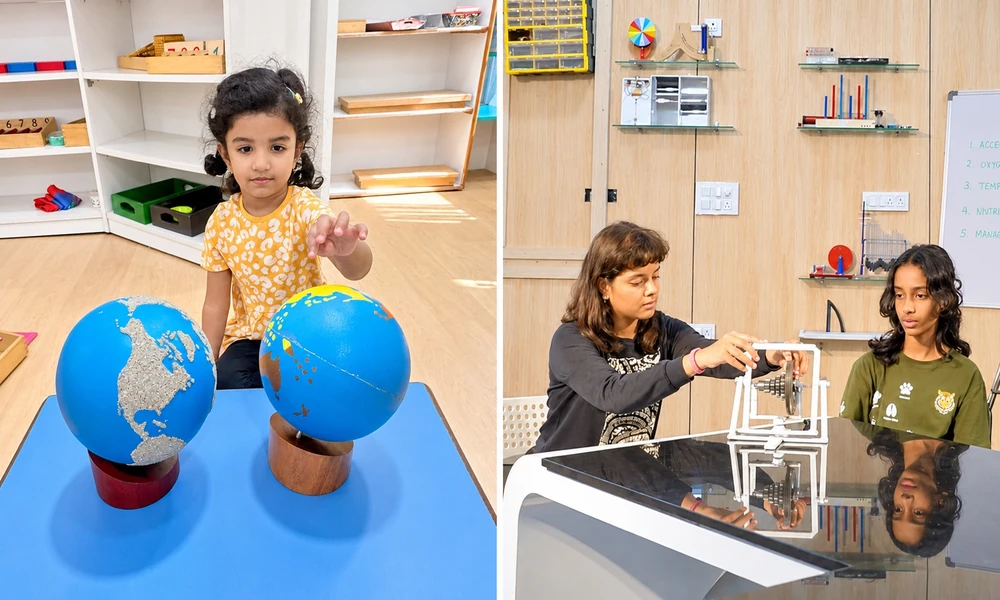
Space learning at a school with space lab hyderabad parents can visit does not begin with a satellite. At Blue Blocks, young children first explore the Montessori globe, with its textured land and smooth water. From six to twelve, the Great Stories invite questions about the universe and how life on Earth is connected.
On 23 August 2023, as Chandrayaan-3 reached the Moon, Blue Blocks inaugurated a Space Lab designed with a team from IIT Hyderabad. Children presented models of the Vikram lander and the Pragyan rover, and the simulations prompted questions about how real landings are achieved.
How do schools teach space and STEM education?
A meaningful space problem connects several subjects at once. Designing a stable orbit requires mathematics. Reading a sensor requires electronics and programming. Protecting components demands an understanding of heat transfer and materials. Budgets, written records and teamwork matter too, and by adolescence real designs demand accurate technical knowledge rather than approximations.
Five levels of school space projects
Not every student space project is an orbital mission, and the differences matter when a school describes its achievements.
The first level is models and simulations, where children construct spacecraft or model orbits and landings without anything leaving the ground. The second is the CanSat, a small instrument package, often the size of a drinks can, lifted and released by a drone, balloon or rocket to record data as it descends. The third is the high-altitude balloon, which can carry instruments into the stratosphere, often around 30 kilometres up. That produces real measurements, but it is not an orbital mission.
The fourth level is the hosted orbital payload: a student-built instrument that rides on a professional spacecraft providing supporting systems such as power or communications. This is real flight hardware, though not an independent satellite. The fifth is the independent satellite, where a student team takes responsibility for the complete spacecraft and its essential subsystems, a far more demanding achievement.
SBB-1 was a CubeSat-format hosted payload, integrated with the MOI-1 spacecraft through the technical partner TakeMe2Space. It was qualified and launched aboard a rocket, but it did not reach orbit. Those are three different milestones.
What is a CubeSat and how do students build it?
A CubeSat uses a standard small-spacecraft format organised around units of roughly 10 centimetres on each side. The SBB-1 students had to move well beyond producing a convincing model. Their hardware required testing, documentation and professional integration.
The project centred on a deceptively simple scientific question: how do spacecraft components respond as an orbit repeatedly carries them between direct sunlight and Earth’s shadow? That cycle can repeat about every ninety minutes, which demands reliable sensors and electronics.
The school’s published mission dashboard describes a custom flight computer based on an ARM Cortex-M7 processor, a nine-degree-of-freedom inertial measurement unit and thermal and environmental sensors. The computer processes data, the inertial unit measures motion and the sensors monitor conditions. Physics becomes engineering.
The children did not work without professional support. A design team from IIT Hyderabad contributed to the Space Lab’s learning environment, while Ronak Samantray and TakeMe2Space provided aerospace collaboration and mission-integration expertise. Student and specialist responsibilities remained distinct throughout.
From ground testing to launch integration
SBB-1 advanced from circuit and sensor checks to engineering qualification and launch integration. The school describes vibration, thermal-vacuum and electromagnetic compatibility testing. A ground-to-flight sequence, including drone-carried sensor trials, helped students understand that a sensor working on a bench has not yet proved it will work in flight, because no ground test can reproduce orbital conditions.
Each test asks the same questions. What was measured? Did it meet the requirement? What changed as a result? Evidence matters more than appearance.
The team also met a responsibility rarely faced by school projects: national authorisation. IN-SPACe, India’s space-sector regulator, authorised the hosted payload under authorisation number PMA/IN-SPACe/AUTH/2026/115. Authorisation and integration are real milestones, but they are not proof of orbital operation.
What happened after the launch anomaly?
On 12 January 2026, the launch operator reported that the first two stages of PSLV-C62 performed normally, followed by an anomaly in the third stage. The payloads could not be placed in their intended orbit, so SBB-1 produced no orbital temperature dataset.
The students still had their designs, test reports and decisions to examine. The school has described follow-on analysis and SBB-2, a successor project. A school-authored case study, Valorization in Orbit, explores what this consequential work meant for the adolescents. It is the school’s own account, not independent proof that every participant developed greater resilience.
The students could not control the rocket, but they could examine their own testing, records and response. Learning to separate those responsibilities is itself a form of scientific judgement.
What are the benefits of space programs in schools?
The benefits of space programs in schools come from bringing mathematics, physics, electronics, communication and ethics into the same problem. Students must ask whether a sensor reading is reliable, whether a component can be repaired, who is responsible for safety and what should happen to equipment left in orbit. Such questions shape the design itself.
Parents weighing up any school with space program india claims will learn little from impressive photographs alone. Ask what the children designed themselves, what specialists handled, which tests were completed, and whether the project was simulated, carried on a balloon, launched or actually operated in orbit. The same questions apply to any school with innovation curriculum hyderabad families are considering.
Frequently asked questions
Is space education only for older children?
No. Young children begin with globes, observation and questions about the natural world. Elementary students investigate the universe through interconnected subjects, and adolescent engineering adds advanced technical work under specialist supervision.
Do children need to be good at mathematics to take part?
Not at the beginning. Observation and curiosity provide a starting point. As projects advance, measurement, geometry, calculation and data analysis become essential, and students must learn them accurately.
Can students without an engineering interest contribute to a space project?
Yes. A real project needs people who keep test records, manage budgets, write reports, correspond with partners and explain the work to others. These roles carry genuine responsibility, and many students discover an interest in the technical side through them.
How can parents nurture an interest in space at home?
Observe the night sky together and keep a simple record of the Moon’s changing shape over a month. Visit a planetarium, read about real missions, including the ones that failed, and encourage your child to ask how something would be tested rather than only how it would look.