

Quick Answer
A Manual Handling Cert in Ireland is a safety qualification awarded after completing a recognised course covering safe load-lifting techniques and ergonomic practices. Under the Safety, Health and Welfare at Work (General Application) Regulations 2007, Irish employers are legally obligated to provide this training to any employee who lifts, carries, or moves loads. Most courses take half a day and are valid for 3 years.
Key Facts at a Glance
| Detail | Information |
| Governing legislation | Safety, Health & Welfare at Work Act 2005; General Application Regulations 2007 |
| Regulatory body | Health & Safety Authority (HSA), Ireland |
| Typical course duration | 3–6 hours (half-day or full-day options) |
| Certificate validity | 3 years (renewal recommended) |
| Delivery formats | On-site, classroom, blended (online theory + practical) |
| Who needs it | Construction, healthcare, retail, warehousing, hospitality, office workers |
| Average cost (Ireland) | €50–€120 per person (group rates available) |
| Accreditation | QQI-aligned; provider-certified |
Introduction: Why Your Manual Handling Cert Matters
Musculoskeletal disorders (MSDs) account for over 30% of all workplace injuries reported to the Health & Safety Authority each year. The single most preventable cause? Unsafe manual handling. Whether you work in a Dublin warehouse, a Cork hotel kitchen, or a Galway hospital ward, the risks are real — and so are the legal consequences for businesses that fail to act.
Obtaining a recognised manual handling cert is not merely a box-ticking exercise. It equips workers with the knowledge and muscle-memory to lift, lower, push, and pull loads safely — dramatically reducing both short-term accidents and long-term chronic injuries.
What Is Manual Handling Training in Ireland?
Manual handling refers to any activity that requires a person to use physical force to lift, lower, carry, push, pull, or move a load. Irish law defines a “load” broadly — it includes inanimate objects, animals, and even people (relevant in healthcare and care-home settings).
What the training covers
- Anatomy of the spine and vulnerable muscle groups
- Risk factors: weight, posture, repetition, environment
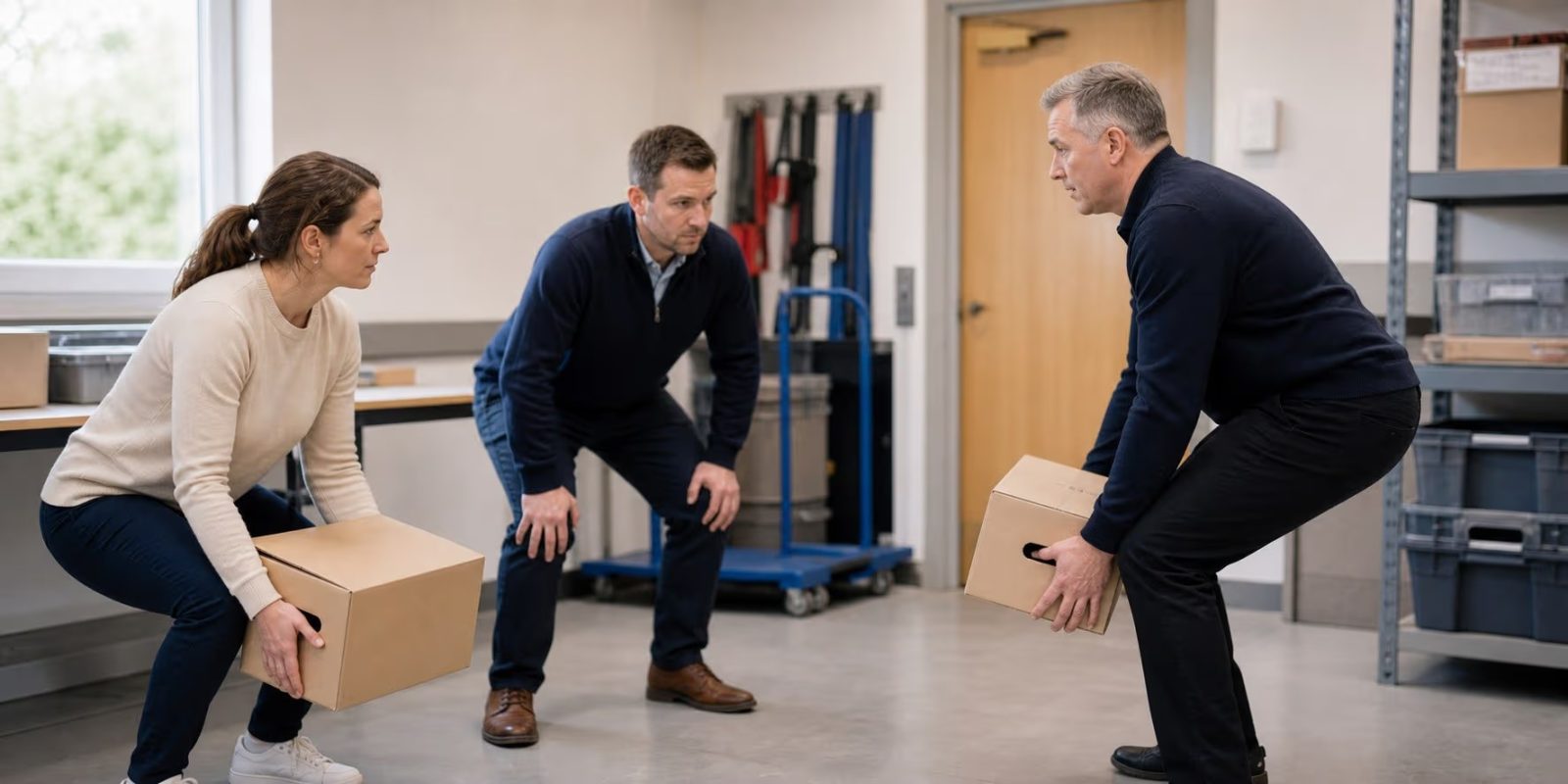
- Correct lifting and lowering techniques (kinetic lifting principles)
- Team lifting and use of mechanical aids
- Practical risk assessment using the HSA’s manual handling risk assessment framework
- Employer and employee duties under Irish law
Course Comparison: Which Manual Handling Course Is Right for You?
| Course Type | Duration | Best For | Format | Cert Issued |
| Standard Manual Handling | Half-day (3–4 hrs) | Office, retail, hospitality | Classroom / on-site | Yes |
| Manual Handling & Abrasive Wheels | Full-day (6–7 hrs) | Construction, manufacturing | Classroom / on-site | Yes |
| People Handling (Moving & Handling) | Full-day (6–7 hrs) | Healthcare, care homes | Practical hands-on | Yes |
| Online Manual Handling (Theory Only) | 1–2 hrs | Low-risk office environments | E-learning | Awareness only |
| Refresher / Renewal Course | 2–3 hrs | Certificate renewal (3-yr cycle) | Blended | Renewal cert |
Note: Pure e-learning courses without a practical component do not satisfy HSA requirements for most manual-handling roles. Always confirm accreditation with your provider.
How to Get Your Manual Handling Cert: Step by Step
- Identify your sector— choose between standard, people-handling, or construction-specific training.
- Select an accredited provider— look for HSA-compliant trainers with verifiable credentials and experience.
- Book your course— on-site delivery at your premises or public scheduled sessions in your area.
- Complete theory & practical modules— both elements must be passed to receive certification.
- Receive your certificate— usually issued same day; valid for 3 years from date of training.
- Schedule renewal— set a diary reminder 2–3 months before expiry to avoid lapses.
Employer Obligations Under Irish Law
The Safety, Health and Welfare at Work (General Application) Regulations 2007, Part 2, Chapter 4 places direct obligations on employers to: assess manual handling risks, modify tasks where possible, and provide adequate training and information to all exposed employees. Failure to comply can result in HSA enforcement action, civil liability for workplace injuries, and significant reputational damage.
Practical tip for employers: Maintain a training register with each employee’s manual handling cert date. The HSA can request these records during an inspection — gaps in documentation are treated as gaps in compliance.
Frequently Asked Questions
- How long is a manual handling cert valid for in Ireland?
A manual handling certificate is typically valid for 3 years from the date of issue. The HSA recommends refresher training at this interval to ensure techniques remain current and legally defensible.
- Is manual handling training a legal requirement in Ireland?
Yes. Under the Safety, Health and Welfare at Work (General Application) Regulations 2007, employers must provide manual handling training to employees whose roles involve moving or handling loads. Failing to do so is a breach of Irish health and safety law.
- Can I do my manual handling cert online?
Theory elements can be completed online, but a practical component is legally required for most roles. Pure e-learning certificates without a hands-on practical session are generally not sufficient for HSA compliance in physical roles.
- How long does the course take?
A standard manual handling course takes approximately 3 to 4 hours (half-day). Full-day courses (6–7 hours) are available for construction, healthcare, or combined qualification programmes.
- Who needs a manual handling cert?
Any worker who regularly lifts, carries, pushes, pulls, or moves loads as part of their job. This includes construction workers, nurses, retail assistants, warehouse operatives, hospitality staff, and office workers who handle deliveries or equipment.
- Is there a maximum weight a person can legally lift in Ireland?
Irish law does not prescribe a specific maximum weight. Instead, it requires employers to assess and reduce risk. However, Health and Safety guidelines suggest that loads above 20–25 kg require additional controls, including mechanical aids or team lifting.
- How much does a manual handling cert cost in Ireland?
Individual course fees typically range from €50 to €120 per person. Group bookings and on-site training for teams of 6 or more are usually more cost-effective and can be arranged at your workplace.
- What is the difference between manual handling and people handling training?
Standard manual handling covers inanimate loads (boxes, equipment, materials). People handling — also called moving and handling — is a specialist course for healthcare and care-home workers who assist patients or service users with mobility, requiring additional practical technique training.
- Do I need to bring anything to the course?
Most providers require comfortable, flat-soled footwear suitable for practical exercises. Some employers request photo ID. No prior qualification or experience is required to attend a standard manual handling course.
- Can training be delivered at our workplace?
Yes. On-site group training is available and is often the preferred option for businesses. It reduces staff travel time, allows the trainer to reference your specific workplace environment, and is typically more cost-effective per head than public sessions.